
Somewhere in the volcanic valley of La Geria, behind a low stone wall with no sign, a woman in her seventies is pouring wine from an unlabelled bottle. The Malvasía is pale gold, almost transparent, with a salinity on the finish that tastes like the island itself. She made 300 bottles this year. Most of them will be drunk by family and neighbours before Christmas. You won't find this wine in any shop, any restaurant, or any listing on the internet.
This is the Lanzarote wine most visitors never encounter. The standard Lanzarote wine tour takes you to three tourist-oriented bodegas, where you taste perfectly good Malvasía in a polished tasting room, buy a bottle from the gift shop, and leave thinking you've seen La Geria. You haven't. You've seen the shopfront.
This guide is about the rest of it. The family bodegas that don't advertise, the grape varieties most people don't know exist, the winemaking traditions that predate modern tourism by two centuries, and why Lanzarote's volcanic wines are genuinely unlike anything produced anywhere else on earth.
Why Lanzarote Wine Is Unlike Anything Else
Every wine region claims to be unique. Lanzarote's claim is the only one that involves farming inside a volcano.
The Eruptions That Created a Wine Region
Between 1730 and 1736, a chain of volcanic eruptions lasting six years buried a quarter of Lanzarote under metres of lava and ash. Farmland that had sustained villages for centuries vanished overnight. What should have been the end of agriculture on the island became, through sheer ingenuity, the beginning of something found nowhere else.
Farmers discovered that the thick layer of volcanic gravel — called picón or lapilli — that covered their land had an extraordinary property. The porous black granules absorbed moisture from the night air and the Atlantic trade winds, trapping it beneath the surface and feeding it slowly to anything planted below. Rather than clearing the ash, they learned to work with it.
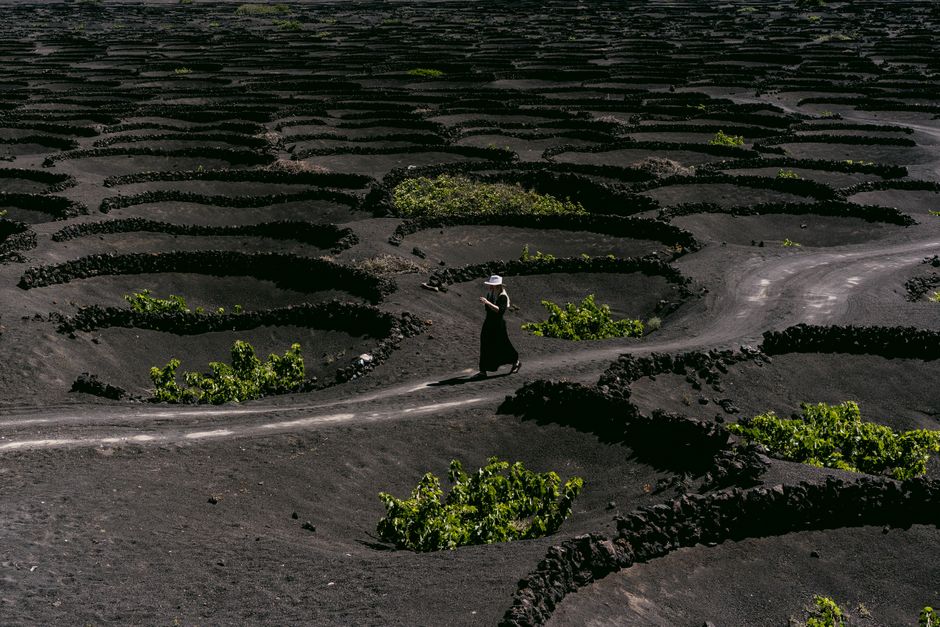
They dug pits, sometimes three metres deep, down through the picón to reach the original fertile soil beneath. Into each pit they planted a single vine. Around each pit they built a semi-circular wall of volcanic stone — a zoco — to shield the vine from the constant northeast wind. The result, repeated across thousands of individual craters stretching from Uga to Teguise, is a landscape that looks from above like the surface of the moon dotted with green.
La Geria is a Protected Landscape under Canarian law, within the island's UNESCO Biosphere Reserve. It's the only wine-growing system of its kind on the planet.
What the Volcanic Soil Does to the Wine
Terroir isn't a marketing concept here. It's literal. The picón doesn't just retain moisture — it imparts a mineral character to the vines that you can taste in the glass. Lanzarote wines carry a volcanic signature: a flinty minerality, a faint salinity, and in the best examples, a smokiness that comes from soil that was once molten rock.
The climate plays its part too. Lanzarote receives less than 150mm of rain per year. The vines are essentially dry-farmed, surviving on condensation alone, which concentrates flavours and keeps yields naturally low. A single vine in La Geria might produce enough grapes for two or three bottles. On the mainland, that same vine would yield ten times as much, and taste ten times less interesting.
The combination — volcanic mineral soil, extreme aridity, oceanic influence from the trade winds, and ancient vines that have never been exposed to phylloxera (the root louse that devastated European vineyards in the 19th century) — produces wines with a character that cannot be replicated anywhere else. This is not a marketing claim. It's geology.
The Commercial Bodegas: What the Standard Wine Tour Covers
Let's be fair to the well-known bodegas. They exist for a reason, and some of them make excellent wine. If you're doing a standard Lanzarote wine tour, here's what you'll typically visit.
Bodega El Grifo
Founded in 1775, El Grifo is the oldest working bodega in the Canary Islands and one of the ten oldest in Spain. The wine museum is genuinely interesting, with 18th-century presses and tools that show how little the basic process has changed. Their dry Malvasía is consistently good, and the Canari (a sweet, aged Malvasía in the style historically exported to Europe) is worth trying for its historical significance alone.
Bodega La Geria
The most visited bodega on the island, positioned on the main road through the wine valley. Large-scale by Lanzarote standards, well-organised tasting room, solid wines. The setting is photogenic — their vineyards with the zocos against the volcanic backdrop are what most people picture when they think of Lanzarote wine. A reliable stop, if a predictable one.
Bodegas Rubicón
Another established producer with a modern facility and a broad range. Their Amalia Brut Nature (a sparkling Malvasía made using the traditional method) is one of the more interesting commercial wines on the island. The restaurant attached to the bodega serves decent food with vineyard views.
These three bodegas account for the vast majority of Lanzarote wine tasting visits. Tour buses arrive mid-morning, groups cycle through the tasting rooms, and by early afternoon the car park is empty. It's efficient, it's pleasant, and it gives you a surface-level introduction to the region.
But the DO Lanzarote covers roughly 1,800 hectares of vineyards across the island, most of them in La Geria. The commercial bodegas represent a fraction of what's actually produced here.
The Secret Bodegas: What Exists Beyond the Tour Circuit
Scattered through the volcanic valley, along unmarked roads and behind unlabelled gates, there are dozens of family bodegas that most visitors never learn about. These aren't failed businesses or hobbyist operations. They're families continuing a tradition that their grandparents and great-grandparents began, making wine in the same zocos, from the same vines, using methods that haven't fundamentally changed since the 18th century.
Why They Don't Advertise
The simplest answer: they don't need to. A family producing 200 to 500 bottles a year has no trouble finding people to drink them. The wine goes to family, to neighbours, to the local restaurants that know to ask, and to the handful of people on the island connected enough to know it exists. There's no surplus that needs a marketing budget.
Many of these bodegas don't have commercial licences. They're not registered as businesses. They don't appear on Google Maps. There's no TripAdvisor listing, no booking link, no tasting menu pinned to a gate. They exist in the space between private life and local tradition — a space that conventional tourism cannot reach.
What Makes Their Wine Different
When you taste wine at a commercial bodega, you're tasting something that has been produced at scale (by Lanzarote standards), professionally bottled, and designed for a broad market. It's good. It's consistent. It's approachable.
The wine from a family bodega is something else entirely. There's a rawness to it, a directness. The winemaker isn't trying to please a panel of judges or fit a commercial profile. They're making wine the way their family has always made it, with the grapes from their specific plot of volcanic soil, fermented in their specific cellar, and it tastes like that place and no other.
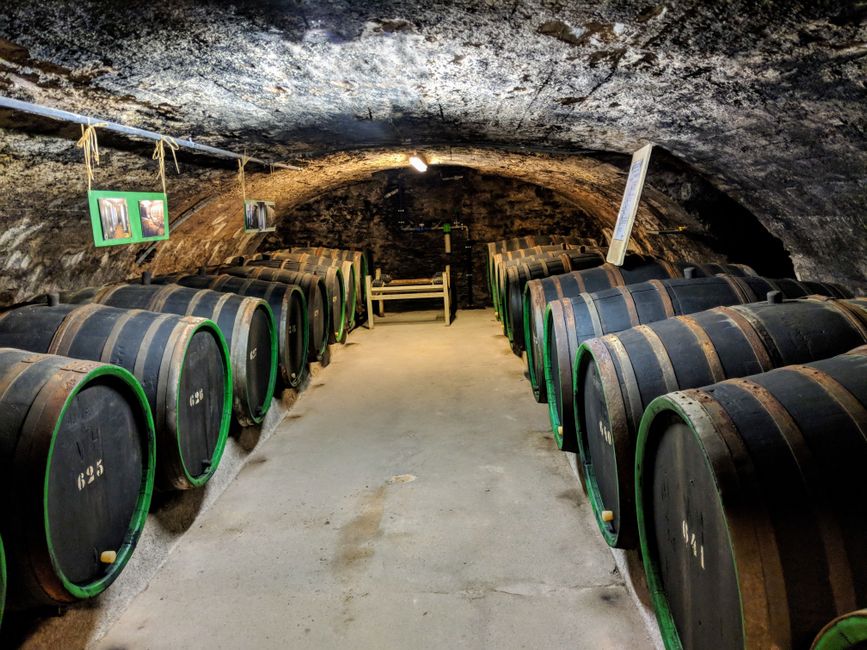
One bodega near Masdache produces a dry Malvasía with a smokiness that lingers for minutes after you swallow. Another family in the hills above Uga makes a Listán Negro — a red from a grape variety that most visitors don't know Lanzarote grows — with a volcanic earthiness and a tannin structure that would surprise anyone who thinks Canarian wines are all light whites. A third, closer to Teguise, ages their Malvasía in old chestnut barrels rather than stainless steel, giving it an amber hue and a complexity that the commercial producers can't match at their volume.
None of these wines have labels you'd recognise. Several don't have labels at all.
The Experience of Visiting
A visit to a family bodega is nothing like a commercial wine tasting. There's no reception desk, no tasting notes printed on card stock, no branded glass to take home. You're in someone's home, or in the small stone building next to their home where the wine is made and stored.
The winemaker — often the person who also pruned the vines, harvested the grapes by hand, and swept the cellar floor that morning — pours directly from the barrel or from a jug. They'll explain the vintage, the weather that year, the particular character of their soil. You'll taste two or three wines, maybe with some local cheese and papas arrugadas that appeared from the kitchen without anyone seeming to prepare them.
The conversation tends to drift from wine to family to the island to the eruptions to grandparents to the particular way the wind hits their particular valley. It's unhurried in a way that a 45-minute tasting slot at a commercial bodega cannot be. You leave with a bottle if they can spare one, and a sense of connection to a place that no tour bus itinerary provides.
This is the Lanzarote wine tasting that doesn't appear on any booking platform. It happens through personal introduction, and it's one of the most genuinely exclusive things to do in Lanzarote — not exclusive in the luxury-brand sense, but in the sense that it simply doesn't exist as a product you can purchase.
The Grapes: What to Look for Beyond Malvasía
Malvasía Volcánica is the headline grape of Lanzarote, and rightly so. It's a subvariety of the Malvasía family that has evolved over centuries in volcanic soil, developing characteristics distinct from its cousins on the Spanish and Italian mainlands. But Lanzarote grows more than Malvasía, and some of the most interesting wines come from varieties that most visitors never hear about.
Malvasía Volcánica
The island's flagship. At its best, dry Malvasía Volcánica is medium-bodied with aromas of white flowers, green apple, and a distinctive mineral edge. The volcanic soil gives it a salinity and a flinty quality that makes it a natural partner for seafood — which is convenient, given where the island is. Semi-sweet and sweet versions (often labelled semi-dulce or dulce) are also traditional, with honey and dried apricot notes balanced by the acidity that the volcanic growing conditions preserve even at higher sugar levels.
Lanzarote's principal red grape, and one that's increasingly catching the attention of wine professionals on the mainland. It produces a medium-bodied red with earthy, volcanic character — think dark fruit, dried herbs, and a minerality that anchors the wine. The best Listán Negro from Lanzarote has a volcanic earthiness that's become the grape's calling card, but production remains small and largely consumed locally.

Diego
This is the one to ask about if you want to impress a local winemaker, or more accurately, if you want to watch their face light up. Diego (also known as Vijariego Blanco) is a white grape variety that was once widely planted across the Canary Islands and mainland Andalusia. It's now rare — wiped out on the mainland by phylloxera and increasingly scarce even in the islands. A limited number of old vines survive in La Geria, tended by families who refuse to pull them out despite Diego's low yields and difficult temperament.
Wine from Diego has an intensity that Malvasía doesn't — more body, more structure, more personality. Very few bottles are produced each year. If you're offered Diego during a wine tasting in Lanzarote, say yes without hesitation. You may not get the opportunity again.
Moscatel
A small amount of Moscatel (Muscat) is grown in Lanzarote, producing aromatic, floral whites that are lighter and more perfumed than Malvasía. Not widely available, but some of the family bodegas make a Moscatel that's excellent as an aperitif — especially chilled, late afternoon, overlooking the volcanic landscape from someone's terrace.
How to Plan a Lanzarote Wine Tour That Goes Deeper
If you're planning to explore Lanzarote's wine region, here's how to get beyond the surface.
The Self-Guided Route Through La Geria
The LZ-30 road runs through the heart of the wine valley between Uga and Teguise. Along this road you'll find the commercial bodegas — El Grifo, La Geria, Rubicón, and a few smaller producers that welcome walk-ins. This is the standard Lanzarote wine tour route, and it's worth doing at least once.
Practical tips:
Start mid-morning. Most bodegas open around 10:30am. The tour buses arrive around 11:30am, so earlier is quieter.
Don't try to visit all three major bodegas. Two is enough. The tastings overlap significantly. Spend the saved time driving the smaller roads off the main valley route.
Bring a designated driver. The tastings are generous, the wine is stronger than you'd expect (typically 12.5-13.5% for whites), and the roads through the lava fields demand attention.
Stop at the roadside viewpoints. The landscape of the wine valley — thousands of individual zocos stretching to the horizon — is one of the most photographed scenes in the Canary Islands, and more striking in person than in any photo.
Beyond the Main Road
The smaller roads that branch off the LZ-30, toward Masdache, through the hills above Uga, and into the less-visited eastern edge of the wine region, are where the valley reveals its quieter side. You'll see bodegas that are clearly family operations — a small stone building, a handful of zocos, a gate that may or may not be open. You won't be able to walk in unannounced (and shouldn't), but driving these roads gives you a sense of the scale and privacy of the small-producer world that the main route only hints at.
Wine and Food: The Pairings That Work
Lanzarote wine is best understood alongside the island's food. The dry Malvasía with grilled vieja (parrotfish) is a combination so natural it feels inevitable. Semi-sweet Malvasía alongside aged goat cheese rubbed with gofio is equally good — the sweetness of the wine against the sharp, earthy cheese is a pairing that locals have been enjoying for generations without needing a sommelier to validate it.
Some of the best Lanzarote food tour experiences combine wine tasting with local gastronomy: cheese from a nearby farm, papas arrugadas prepared traditionally, olives cured in volcanic salt from Janubio. These pairings work because they come from the same soil, the same climate, and the same tradition.
Explore our private wine tour experience
Wine Festivals and Seasonal Events
If your visit to Lanzarote coincides with the wine calendar, you'll experience a side of the island that tourism barely touches.
La Vendimia: The Grape Harvest
The grape harvest in Lanzarote typically falls between late July and early September, depending on the year's conditions. During la vendimia, the valley comes alive before dawn. Families harvest by hand — there's no other option when each vine sits in its own individual crater — and the work is communal, with extended families and neighbours pitching in together.
In some villages, the end of the harvest is marked with a local fiesta. These aren't tourist events. They're village celebrations with food, wine (a lot of wine), music, and the particular relief of another vintage safely in. If you're on the island during harvest time, ask around. Someone will know where the celebration is.
Fiestas de La Geria
Around mid-August, the wine valley hosts its own fiestas, with traditional grape-harvest recreations, food, music, and plenty of local wine. Several bodegas open their doors, and the celebration has the character of a village gathering rather than a tourist event. Check local listings for the exact dates, which vary each year. Other wine-related events take place throughout the harvest season — your best source for these is word of mouth from the winemakers themselves.
Buying Lanzarote Wine: What to Bring Home
One of the frustrations of discovering Lanzarote wine is that you can't easily get it once you leave. The island produces roughly 2 million litres per year — a tiny fraction of Spanish wine output — and the majority is consumed locally or sold to mainland Canary Islands. Very little is exported.
What to look for:
Dry Malvasía Volcánica — the region's definitive wine. Every bodega makes one. Buy a bottle from a producer you visited and liked.
Canari or Malvasía Dulce — the sweet, aged style that Lanzarote historically exported to European courts. El Grifo's version is the most accessible. Rich, honeyed, and complex.
Listán Negro — if you can find one from a smaller producer, bring it home. These reds are increasingly impressive and almost impossible to source outside the island.
Diego — if you find a bottle, buy it. Full stop.
Where to buy: The bodega shops offer their own wines, obviously. For a broader selection including smaller producers, look for specialist wine shops in Arrecife and Teguise. The weekly markets (Teguise Sunday, Haría Saturday) sometimes have local wines, though the best ones sell out early.
Why the Standard Wine Tour Isn't Enough
Here's the honest assessment. The standard Lanzarote wine tour — drive to La Geria, visit two or three commercial bodegas, taste, buy, leave — is a fine way to spend a morning. You'll learn the basics of volcanic viticulture, taste wines you won't find at home, and drive through a landscape that's genuinely extraordinary.
But it's a bit like visiting Burgundy and only stopping at the supermarket wine aisle. The real La Geria, the one the winemakers themselves inhabit, exists in the family bodegas behind the unmarked gates. It exists in the conversation you have with someone whose relationship with this volcanic soil stretches back generations. It exists in the glass of Malvasía that was never meant for commercial sale, poured by the person who grew the grapes and made the wine, in the same cellar where their grandfather did the same thing.
That version of Lanzarote's wine culture is the one we spend our time facilitating at Lanzarote Untold. We've built relationships with family winemakers across La Geria over years — the kind of trust that can't be rushed and can't be faked. When we take someone to a private bodega, it's because we know the family, they know us, and the experience is genuine.
No large groups. No standardised tasting menus. No experience you could replicate from a Google search. Just access to a world of wine that exists quietly, privately, and beautifully, in one of the most unique viticultural landscapes on the planet.
Discover our private & bespoke experiences
Frequently Asked Questions
What wine is Lanzarote known for?
Lanzarote is known for Malvasía Volcánica, a white wine grown in volcanic soil using a unique cultivation method where each vine sits in its own hand-dug pit protected by a semi-circular stone wall called a zoco. The volcanic picón gravel retains moisture from the trade winds, allowing vines to grow with virtually no rainfall. The resulting wines have a distinctive mineral character, with flinty, saline notes unique to this volcanic terroir. Dry, semi-sweet, and sweet versions are produced, along with smaller quantities of Listán Negro (red) and the rare Diego variety.
Is a Lanzarote wine tour worth it?
A Lanzarote wine tour is one of the most worthwhile things to do on the island. The volcanic wine region of La Geria is a UNESCO-recognised cultural landscape unlike anywhere else in the world, and the wines themselves — shaped by volcanic soil, extreme aridity, and centuries-old growing methods — have a character you genuinely can't find elsewhere. The commercial bodegas (El Grifo, La Geria, Rubicón) offer a good introduction. For a deeper experience, a private tour of the family-run bodegas reveals a side of Lanzarote's wine culture that standard tours don't cover.
How many bodegas are in Lanzarote?
Lanzarote has over 30 registered bodegas under the DO Lanzarote denomination, a number that has grown significantly in recent years. But the total number of producers is far higher when you include the many family operations that make wine for personal consumption and local sale without commercial licences. The La Geria wine valley alone contains dozens of small family bodegas. Most of these are not open to the public and don't advertise — they're only accessible through local connections.
What food pairs well with Lanzarote wine?
Dry Malvasía Volcánica is a natural match for Lanzarote's fresh seafood, especially grilled vieja (parrotfish) and cherne (wreckfish) with mojo verde. Semi-sweet Malvasía pairs beautifully with the island's aged goat cheese, particularly varieties rubbed with gofio (toasted grain flour) or pimentón. Listán Negro reds complement heartier dishes like slow-cooked goat or carne fiesta (marinated pork). The island's volcanic flor de sal from the Janubio salt pans is used by local winemakers when preparing food alongside their wines.
Can I visit Lanzarote wineries without a tour?
The commercial bodegas along the LZ-30 road through La Geria (El Grifo, Bodega La Geria, Bodegas Rubicón) welcome walk-in visitors for tastings during opening hours. Several smaller registered bodegas also accept visitors but may require advance booking. The family bodegas — the small, non-commercial producers that make some of the island's most interesting wine — are not accessible without a personal introduction. For these, you need someone who knows the families.
Want to go beyond the standard Lanzarote wine tour and visit the bodegas that don't appear on any map? Get in touch with our team to arrange a private wine experience in La Geria. Or read our guide to Lanzarote's hidden gems for more of the island the tourist trail doesn't cover.